1/6
Weekly Cosmos Digest: supernova siblings, salt clouds, and Mars weather
22/6/2026 · 8:17
Galería
Weekly Cosmos Digest
Five space stories from the latest weekly scan, chosen for clear science value and strong visual context. Each slide gives the short version: what happened, why it matters, and the takeaway.
1. Fermi may have found sibling supernova remnants
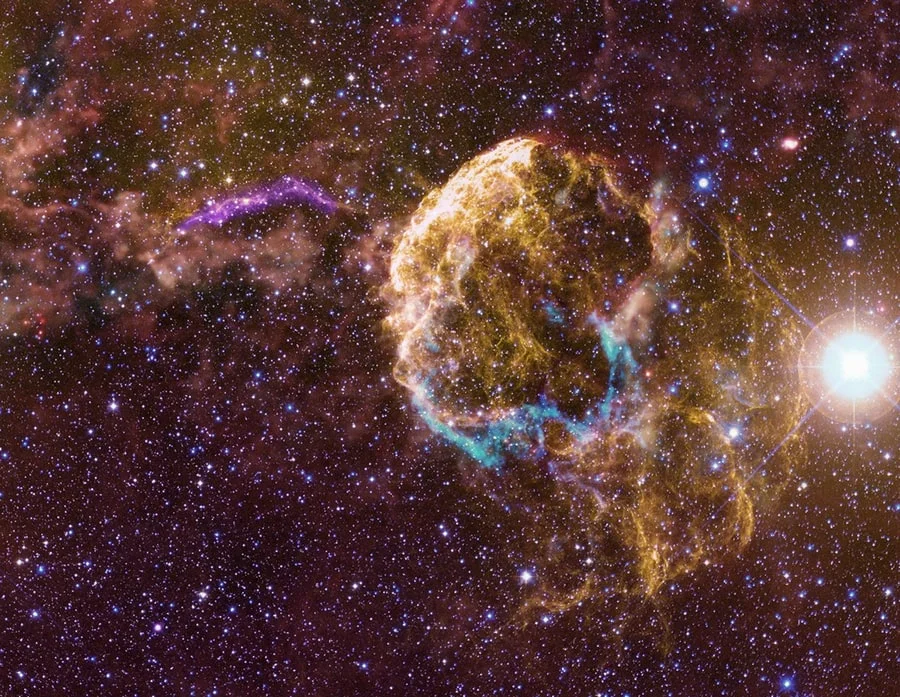
NASA's Fermi Gamma-ray Space Telescope helped identify a likely pair of supernova remnants from two massive stars that once orbited each other: the Jellyfish Nebula, also called IC 443, and the fainter G189.6+3.3. Both are about 6,000 light-years away, and their projected blast centers sit roughly 40 light-years apart. 1
Why it matters: if confirmed, this would be a rare real-world case of both stars in a massive binary system ending as separate supernovae. The pair also gives astronomers a new way to study how supernova remnants accelerate particles into cosmic rays.
Takeaway: one patch of Gemini may preserve two linked stellar deaths, not just one.
2. The Pink Planet has salty clouds
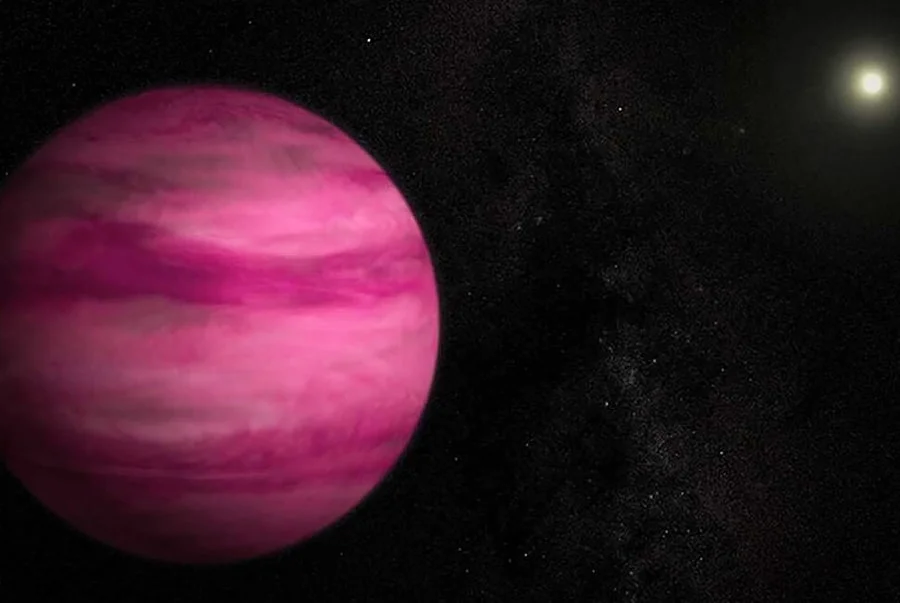
The directly imaged world GJ 504b, often nicknamed the Pink Planet, is about 57 light-years away and roughly 25 Jupiter masses. A Northwestern-led team used JWST to detect water vapor, methane, carbon dioxide, ammonia, and evidence that salt clouds are needed to explain its atmosphere. 2
Why it matters: salt clouds had been predicted for cold planetary atmospheres, but direct evidence has been hard to get. JWST is turning faint, cold objects from blurry dots into worlds with weather chemistry.
Takeaway: even a small, faint point of light can reveal a layered alien atmosphere.
3. Lucy's asteroid is a wobbling peanut
NASA's Lucy spacecraft flew past asteroid Donaldjohanson in 2025, and the new analysis shows a bilobate, peanut-shaped object with complex motion: it tumbles end over end every 10.5 Earth days and wobbles around its long axis every 26.5 days. 3
Lucy also detected iron-rich clay minerals, a clue that the asteroid's material briefly interacted with liquid water in the past. That makes Donaldjohanson a useful comparison point for Bennu and Ryugu, which show signs of longer water exposure.
Takeaway: one asteroid flyby can preserve clues about spin, impacts, and ancient water in the main belt.
4. Hubble looks through a merging galaxy cluster
Hubble's view of CL0016+1609, also known as MACS J0018.5+1626, shows a dense field of galaxies in a cluster system that X-ray observations indicate is actually two clusters merging along our line of sight. 4
Why it matters: clusters like this act as natural lenses. Their gravity bends and magnifies light from more distant galaxies, helping astronomers map dark matter and find early-universe galaxy candidates.
Takeaway: a messy cluster merger can work like a cosmic telescope.
5. NASA and Relativity Space make a Mars weather bet
NASA announced a public-private partnership with Relativity Space for Aeolus, a Mars atmospheric science mission targeted for launch in 2028. NASA will provide a four-instrument science payload, while Relativity will provide the spacecraft, rocket, cruise operations, and mission operations. 5
Aeolus is designed to deliver daily global views of Martian winds, temperatures, dust, and clouds. The goal is not just better weather maps: those data can reduce risk for future robotic and human landings.
Takeaway: Mars exploration needs forecasts, not just maps.
Sources are placed next to the facts they support. Official mission and institution pages were prioritized over secondary coverage.
Comentar