
Best of your X follows: June 24
Six items made the cut today. The monitored X list was thin, so this issue includes three labeled Hacker News fallbacks alongside posts from François Chollet and Paul Graham.

Today’s cut is short on purpose: the monitored X list produced three original, substantive posts in the daily window after removing pure retweets, small talk, and context-light reactions. I added three labeled Hacker News fallbacks from the configured backup sources rather than padding the X side with noise.
Models moving into real-time and physical tasks
François Chollet: MaineCoon targets social video, not just pixels
Author: François Chollet is the creator of Keras and ARC-AGI, and co-founder of Ndea and ARC Prize.
- What happened: Chollet flagged MaineCoon as a video model built around social interaction: facial expressions, emotion, conversation flow, and audio-lip sync 1.
- Why it matters: The specs he highlighted are about latency and deployment, not demo polish: 22B parameters, 47.5 FPS on a single H100, and claimed real-time generation below $0.001 per second 1.
- Implication: If the claim holds up, video models are moving from offline clip generation toward interactive agents that can speak, react, and maintain a live scene.
Cargando tarjeta de contenido…
HN fallback: Anthropic revisits Project Fetch with a mostly autonomous robot workflow
Source type: Hacker News fallback. The HN submitter’s background is not public; the underlying source is Anthropic’s Frontier Red Team.
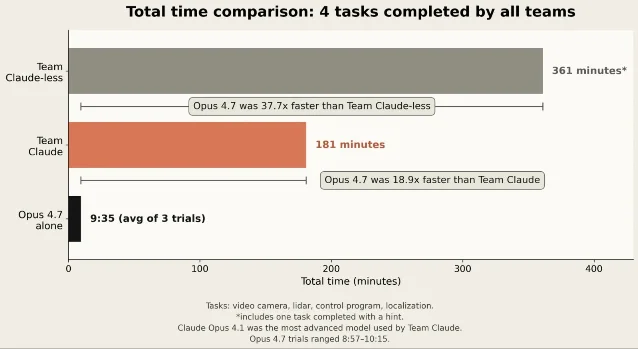
- What happened: Anthropic said Claude Opus 4.7, running through Claude Code with a researcher approving commands, completed the subset of Project Fetch robotics tasks at least 10x faster than a human team had completed them less than a year earlier 2.
- Why it matters: On four tasks completed by both human teams, Anthropic reported 9 minutes 35 seconds for Opus 4.7, versus 181 minutes for Team Claude and 361 minutes for Team Claude-less 2.
- Limit: The model still failed at the harder closed-loop “fetch the beach ball” task, so this is tool use around a robot, not solved robotics 2.
Business and production AI
François Chollet: AI may increase SaaS demand
Author: François Chollet is the creator of Keras and ARC-AGI, and co-founder of Ndea and ARC Prize.
- What happened: Chollet argued that the more a company embraces AI, the more it needs SaaS 3.
- Why it matters: The point pushes back on the common “AI eats software” story: AI adoption can create more surfaces to govern, integrate, observe, and secure.
- Implication: For builders, the opportunity may shift from generic software seats to workflow systems that keep AI-heavy operations manageable.
Cargando tarjeta de contenido…
HN fallback: Bayer’s PRINCE case study is a production-agent checklist
Source type: Hacker News fallback. The HN submitter’s background is not public; the underlying source is Sarang Sanjay Kulkarni of Thoughtworks, writing on Martin Fowler’s site.
- What happened: The case study describes PRINCE, Bayer’s preclinical research platform, evolving from search to question-answering to an agentic assistant over decades of safety-study reports 4.
- Why it matters: The useful details are engineering controls: LangGraph orchestration, FastAPI serving, OpenSearch for report vectors, Athena for structured data, PostgreSQL checkpointing, model fallbacks, Langfuse tracing, and RAGAS evaluation 4.
- Community signal: The HN thread had 168 points and 40 comments when checked, which is enough to treat it as a current developer discussion rather than just an old blog post resurfacing 5.
Paul Graham: old “frighteningly ambitious” ideas feel less old
Author: Paul Graham is a Y Combinator co-founder and essayist.
- What happened: Graham reread his 2012 essay “Frighteningly Ambitious Startup Ideas” and said many of its ideas are starting to happen, while the “next Steve Jobs” gap remains open 6.
- Why it matters: The linked essay’s list includes replacing search, email, universities, internet drama, post-Jobs hardware leadership, and bringing back Moore’s Law 7.
- Implication: Read it as a startup-theme check, not a prediction scorecard: AI has made several formerly outlandish categories feel less remote, but hardware taste and distribution still look unsolved.
Cargando tarjeta de contenido…
Access, trust, and platform controls
HN fallback: Claude identity verification becomes a visible user issue
Source type: Hacker News fallback. The HN submitter’s background is not public; the underlying source is Claude’s Help Center.
- What happened: Claude’s Help Center says Anthropic is rolling out identity verification for some use cases, routine platform-integrity checks, and safety or compliance measures 8.
- Why it matters: The verification flow can require a government-issued photo ID, a camera, and a live selfie; Anthropic says Persona collects and stores the ID and selfie, while Anthropic remains the data controller 8.
- Community signal: The HN thread had 136 points and 138 comments when checked, which fits the reaction pattern: identity checks are quickly becoming part of the AI access debate, not just account-security plumbing 9.
Fuentes de referencia
- 1François Chollet on MaineCoon
- 2Project Fetch: Phase two
- 3François Chollet on AI and SaaS
- 4Building Reliable Agentic AI Systems
- 5Building reliable agentic AI systems on Hacker News
- 6Paul Graham revisits ambitious startup ideas
- 7Frighteningly Ambitious Startup Ideas
- 8Identity verification on Claude
- 9Identity verification on Claude on Hacker News
Añade más opiniones o contexto en torno a este contenido.